
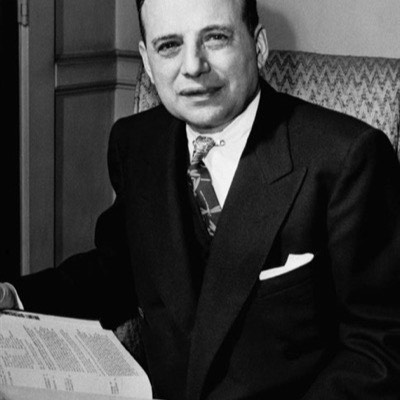
Benjamin Graham
Author and early architect of value investing
Wrote foundational books on security analysis and taught the idea of a margin of safety. He was an early teacher of Warren Buffett.
Photo: Unknown author, Public domain · Wikimedia Commons
Biography
Benjamin Graham, born in London in 1894 and raised in New York, was an investor, professor, and author often described as an early architect of value investing. After graduating from Columbia University, he built a career on Wall Street and began developing a disciplined, analytical way of valuing securities.
With David Dodd he wrote Security Analysis in 1934, and in 1949 he published The Intelligent Investor, a book aimed at ordinary readers that remains widely recommended today. Through his Graham-Newman firm and his teaching at Columbia, he trained a generation of investors, including Warren Buffett.
Graham taught the idea of a margin of safety: buying only when the price sits comfortably below a careful estimate of intrinsic value, so that errors and bad luck do less damage. He also used the metaphor of Mr. Market, an imaginary partner whose mood swings offer prices a calm investor can accept or ignore.
He distinguished between defensive investors, who want simplicity and safety, and enterprising investors, who are willing to do more work for the chance of better results. Graham died in 1976, but his focus on discipline, valuation, and emotional control continues to shape how value investing is taught.
Career timeline
- 1894Born in London; his family soon moves to New York.
- 1914Graduates from Columbia University and begins working on Wall Street.
- 1926Forms the Graham-Newman investment partnership.
- 1934Publishes Security Analysis with David Dodd.
- 1949Publishes The Intelligent Investor for a general audience.
- 1956Retires from active money management and continues teaching.
- 1976Dies, having taught and influenced a generation of investors.
Key ideas
Tap any idea to expand a plain-English explanation, why it matters, and where to learn more.
Margin of safety
Buying only when the price sits well below a careful estimate of what an investment is worth, leaving room for mistakes.
Estimates of value are never exact. A margin of safety cushions errors and bad luck instead of relying on everything going right.
If you estimate a business is worth about 100 dollars per share, you might wait to buy near 70, so a wrong estimate still leaves a buffer.
Mr. Market
A metaphor for the market as a moody partner who offers a different price every day, sometimes cheerful and sometimes fearful.
It reframes price swings as offers you can take or leave, which helps an investor act on judgment rather than emotion.
When Mr. Market panics and quotes low prices, a patient investor can treat it as an opportunity rather than a warning.
Intrinsic value
An estimate of what a business is genuinely worth, based on its earnings and assets, rather than its current quoted price.
Comparing price to a careful estimate of value is the core of value investing and helps judge whether a stock looks cheap or expensive.
A company's share price can drift far above or below a reasonable estimate of the long-term worth of the business.
Defensive investing
A simple, low-effort approach for investors who want safety and steadiness rather than spending time on detailed analysis.
Graham argued that most people are better served by a defensive, diversified approach than by frequent trading they cannot sustain.
Holding a broad, diversified mix and adding to it regularly fits the defensive investor Graham described.
Value investing discipline
Sticking to a consistent, evidence-based process for valuing investments instead of following forecasts, tips, or crowds.
Discipline is what lets the other ideas work, because it keeps an investor from abandoning a sound process under pressure.
A value investor decides in advance what to pay, then follows that rule even when the headlines are loud.
Major contributions
- Helped lay the intellectual foundation of value investing through Security Analysis and The Intelligent Investor.
- Introduced widely used ideas such as the margin of safety and the Mr. Market metaphor.
- Taught and influenced a generation of investors at Columbia, including Warren Buffett.
- Made the case that analyzing a business is different from speculating on its share price.
Influence on investors
Graham's books are still recommended to new investors, and his vocabulary of intrinsic value and margin of safety remains standard in value investing.
His most famous student, Warren Buffett, built on these ideas and credited Graham's teaching, which carried Graham's influence to a very wide audience.
Criticisms and debates
A balanced view includes the main criticisms and open debates, presented neutrally.
- His strict, quantitative value metrics can miss asset-light or fast-growing modern businesses whose worth is harder to measure.
- The deep-bargain stocks his early methods relied on are far rarer today, which makes the original approach harder to apply.
- Even Buffett later moved beyond pure Graham-style value toward paying up for higher-quality businesses.
- A focus on cheapness alone can lead to so-called value traps, where a stock is cheap because the business is declining.
Lessons for investors
Plain-English takeaways. Context for learning, not advice to buy or sell anything.
- 1Leave a margin of safety between price and your estimate of value.
- 2Treat the market's mood swings as opportunities, not instructions.
- 3Separate the price of a stock from the value of the business behind it.
- 4Analysis and discipline tend to age better than forecasts.
Notable quotes
“In the short run, the market is a voting machine, but in the long run it is a weighing machine.”
“The intelligent investor is a realist who sells to optimists and buys from pessimists.”
Frequently asked questions
Who was Benjamin Graham?
Benjamin Graham was an investor, professor, and author often described as an early architect of value investing. He wrote Security Analysis and The Intelligent Investor and taught Warren Buffett.
What is the margin of safety?
The margin of safety is the gap between an investment's price and a careful estimate of its value. Buying with a margin of safety leaves room for mistakes and bad luck.
What is Mr. Market?
Mr. Market is Graham's metaphor for the stock market as a moody partner who offers a different price each day. It encourages investors to treat prices as offers they can accept or ignore.
What can investors learn from Benjamin Graham?
Common takeaways include separating a stock's price from the value of the business, leaving a margin of safety, and staying disciplined instead of reacting to the market's mood.
What are criticisms of Graham's approach?
Critics note that strict value metrics can miss asset-light or fast-growing companies, that deep bargains are rarer today, and that a focus on cheapness alone can lead to value traps.
Is this page investment advice?
No. This is a neutral educational summary written for learning. It is not financial advice.
Related learning
Related people

Get smarter about investing
Clear market insights, useful tools, and beginner-friendly investing education.
Educational content only. This is a neutral summary compiled for learning. It is not an endorsement, not investment advice, and not a claim that this person is always right. Mentioning someone here does not imply they are affiliated with Money Masters Media.