
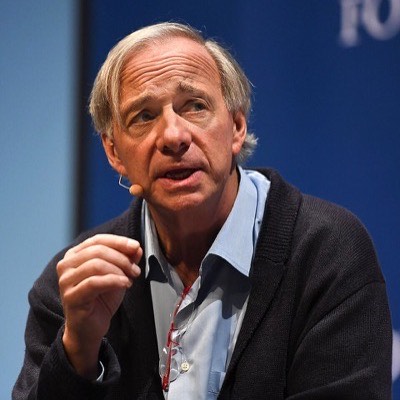
Ray Dalio
Founder of Bridgewater Associates
Built one of the largest hedge funds and wrote widely about economic cycles, diversification, and balancing risk across assets.
Photo: Web Summit, CC BY 2.0 · Wikimedia Commons
Biography
Ray Dalio, born in New York in 1949, is an American investor who founded Bridgewater Associates in 1975 and built it into one of the world's largest hedge funds. He is known for writing openly about how he believes the economy works as a series of cycles driven by credit, interest rates, and productivity.
Dalio popularized ideas such as diversifying across economic environments and balancing risk rather than trying to forecast the future precisely. His All Weather approach, an early risk-balanced strategy, aims to hold up across a range of conditions instead of betting on one outcome.
He has shared much of his thinking in books and free materials, including the widely viewed video How the Economic Machine Works and the best-selling book Principles. He also built a workplace culture at Bridgewater that he calls radical transparency.
Over several years Dalio stepped back from running the firm, completing a transition that handed over control of Bridgewater in 2022. He has continued to write about debt, cycles, and the global economy.
Career timeline
- 1949Born in New York.
- 1975Founds Bridgewater Associates from his apartment.
- 1996Launches the All Weather approach, an early risk-balanced strategy.
- 2008Bridgewater navigates the global financial crisis, raising his public profile.
- 2017Publishes Principles, a widely read book on his decision-making approach.
- 2022Completes a transition, handing over control of Bridgewater.
Key ideas
Tap any idea to expand a plain-English explanation, why it matters, and where to learn more.
Economic cycles
Dalio describes the economy as moving through repeating cycles of expansion and contraction, driven by credit, spending, and productivity.
Seeing booms and busts as part of a pattern can help investors stay calmer and plan, instead of reacting to each headline.
Periods of easy borrowing often fuel growth, which can later reverse when those debts must be repaid.
Diversification
Spreading money across different assets and economic environments so that no single outcome dominates the portfolio.
Dalio calls diversification one of the few ways to reduce risk without necessarily reducing expected return.
A mix that includes stocks, bonds, and other assets can hold up better than betting everything on one.
Risk parity
Building a portfolio so that each part contributes a similar amount of risk, rather than weighting only by dollars.
It aims for steadier results across different conditions, though it has limits and does not always work.
The All Weather approach tries to balance risk across growth, inflation, and other environments.
Debt cycles
The idea that borrowing builds up over short and long cycles, and that large debt build-ups eventually have to be worked off.
Understanding debt cycles can help explain why economies and markets sometimes shift sharply.
A long build-up of debt can lead to a painful period of paying it down, which affects growth and asset prices.
Macro investing
A top-down style that studies economies, interest rates, and currencies to guide decisions across many markets.
Macro conditions can affect nearly every asset, so a big-picture view can matter as much as any single company.
Decisions might be based on the direction of interest rates or growth rather than one company's earnings.
Major contributions
- Built Bridgewater Associates into one of the largest hedge funds in the world.
- Popularized risk-balanced, all-weather portfolio ideas for a broad audience.
- Shared accessible explanations of how the economy works, including a widely viewed free video and best-selling books.
- Promoted a transparent, principles-based approach to decision-making.
Influence on investors
Dalio's writing on cycles and diversification has shaped how many investors think about balancing risk rather than forecasting precisely. His free materials made macro ideas more accessible to beginners.
His book Principles popularized a structured, written approach to decisions that spread beyond finance into business and management.
Criticisms and debates
A balanced view includes the main criticisms and open debates, presented neutrally.
- Macro frameworks can be hard to apply in practice, since timing economic shifts is difficult.
- Risk-parity strategies can struggle when stocks and bonds fall at the same time, as in some recent periods.
- Some argue that broad cycle models explain the past better than they predict the future.
- Bridgewater's radical-transparency culture has been described by some former employees as unusually intense.
Lessons for investors
Plain-English takeaways. Context for learning, not advice to buy or sell anything.
- 1Spread risk across different economic environments instead of one outcome.
- 2Diversification is one of the few low-cost ways to reduce risk.
- 3Write down your principles so decisions stay consistent under stress.
- 4Expect cycles: booms and downturns are normal, not surprises.
Notable quotes
“He who lives by the crystal ball is destined to eat broken glass.”
Frequently asked questions
Who is Ray Dalio?
Ray Dalio is an American investor who founded Bridgewater Associates, one of the world's largest hedge funds, and writes widely about economic cycles and diversification.
What is Ray Dalio known for?
He is known for building Bridgewater, for risk-balanced all-weather portfolio ideas, and for accessible explanations of how the economy works through credit and debt cycles.
What is risk parity?
Risk parity is a way of building a portfolio so that each asset contributes a similar amount of risk, aiming for steadier results across conditions. It has limits and does not always work.
What can investors learn from Ray Dalio?
Common takeaways include diversifying across economic environments, expecting cycles, balancing risk, and writing down principles so decisions stay consistent under stress.
What are criticisms of Ray Dalio's approach?
Critics note that macro timing is hard, that risk parity can struggle when stocks and bonds fall together, and that cycle models can explain the past better than predict the future.
Is this page investment advice?
No. This is a neutral educational summary written for learning. It is not financial advice.
Related learning
Related people

Get smarter about investing
Clear market insights, useful tools, and beginner-friendly investing education.
Educational content only. This is a neutral summary compiled for learning. It is not an endorsement, not investment advice, and not a claim that this person is always right. Mentioning someone here does not imply they are affiliated with Money Masters Media.