
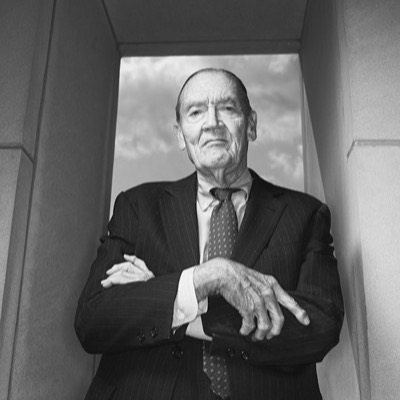
Harry Markowitz
Economist and founder of modern portfolio theory
Born 1927 • Passed away 2023
Showed mathematically how combining assets that move differently can reduce a portfolio’s risk for a given level of return.
Biography
Harry Markowitz was an American economist, born in 1927, who established that a portfolio is a different object from the securities inside it. Before his work, selecting investments was largely understood as picking good ones individually. Markowitz showed that how holdings move in relation to each other determines a portfolio’s risk, and that this relationship can be written down.
The argument appeared in Portfolio Selection, published in the Journal of Finance in 1952 while he was a graduate student at the University of Chicago, and was developed into a book in 1959. It gave a precise meaning to the observation that spreading money around reduces risk: what matters is not the number of holdings but the degree to which they fail to move together.
He shared the Nobel Memorial Prize in Economic Sciences in 1990 with Merton Miller and William Sharpe. His career was not confined to finance. He worked at the RAND Corporation and developed SIMSCRIPT, a simulation programming language, which is a reminder that the portfolio work came from someone thinking about optimisation problems generally.
Markowitz passed away in 2023. The framework he introduced is now assumed rather than argued for: the language of expected return, variance and correlation is the default vocabulary of portfolio construction, including in tools that never mention his name.
Career timeline
- 1927Born in Chicago, Illinois.
- 1952Publishes "Portfolio Selection" in the Journal of Finance.
- 1955Completes a PhD in economics at the University of Chicago.
- 1959Publishes Portfolio Selection: Efficient Diversification of Investments.
- 1960sWorks at the RAND Corporation and develops the SIMSCRIPT simulation language.
- 1989Receives the John von Neumann Theory Prize.
- 1990Shares the Nobel Memorial Prize in Economic Sciences with Merton Miller and William Sharpe.
- 2023Passes away at the age of 95.
How he framed the problem
Markowitz’s central move was to change the unit of analysis. A security has an expected return and a variance, but so does a portfolio, and the portfolio’s variance is not the average of its holdings’ variances. It depends on covariance. Once that is stated formally, diversification stops being a rule of thumb and becomes a calculation with a determinate answer.
The second idea is the efficient frontier. For any level of risk an investor is willing to accept there is a combination of assets offering the highest expected return, and portfolios below that line are simply worse than available alternatives. This reframed the question from "is this a good investment" to "does adding this improve the whole".
He was explicit that the framework requires inputs, and that the inputs are estimates. The mathematics is exact; the expected returns, variances and correlations fed into it are not, and much of the later criticism of mean-variance optimisation concerns exactly that gap.
Key ideas
Tap any idea to expand a plain-English explanation, why it matters, and where to learn more.
A portfolio is judged as a whole
The risk of a portfolio depends on how its holdings move together, not on the riskiness of each holding considered alone.
It explains why adding a volatile asset can lower total portfolio risk, which is impossible to see if you assess holdings one at a time.
Two assets that each swing widely but rarely swing together can combine into a portfolio steadier than either one.
Covariance, not count
Diversification works through low correlation. Owning many things that move together is not diversified.
It is the difference between holding twenty funds that track the same market and holding assets that behave differently from one another.
A portfolio of twenty technology stocks has many holdings and little diversification, because the holdings share the same drivers.
The efficient frontier
For each level of risk there is a portfolio with the highest expected return, and the set of those portfolios forms a frontier.
It gives a standard for judging a portfolio: not whether it made money, but whether a better combination was available for the same risk.
A portfolio sitting below the frontier could, in principle, have kept the same risk and offered more expected return.
Risk has to be defined before it can be managed
Markowitz used variance of returns as the working definition of risk, which made the problem tractable.
Any framework that manages risk needs a measurable definition, and the choice of definition shapes every answer that follows.
Variance treats upside and downside movement alike, which is one reason later work explored alternative measures.
Major contributions
- Published Portfolio Selection in 1952, introducing mean-variance analysis to finance.
- Defined the efficient frontier, giving a formal standard for comparing portfolios.
- Established covariance rather than the number of holdings as the mechanism behind diversification.
- Extended the framework into a full treatment in his 1959 book.
- Developed the SIMSCRIPT simulation language during his work at the RAND Corporation.
Major successes
- Shared the Nobel Memorial Prize in Economic Sciences in 1990 with Merton Miller and William Sharpe.
- Received the John von Neumann Theory Prize in 1989 for contributions to operations research.
- Saw mean-variance analysis become the standard framework taught in finance courses worldwide.
- Had his framework adopted as the basis for institutional asset allocation practice.
Important books
- Portfolio Selection: Efficient Diversification of Investments1959
The full development of the 1952 paper, setting out mean-variance analysis and the efficient frontier in detail.
Influence on investors
Almost every asset-allocation tool in use today assumes the Markowitz framework whether or not it says so. The habit of describing a portfolio by its expected return and its variability, and of asking whether an addition improves the combination rather than whether it is attractive alone, comes from this work.
His framework also underpins the strategies that followed. The 60/40 portfolio, risk parity and the permanent portfolio are all answers to the question he posed about how holdings should be combined, and they differ mainly in what they assume about the inputs.
Criticisms and debates
A balanced view includes the main criticisms and open debates, presented neutrally.
- The model requires expected returns, variances and correlations as inputs, and small errors in those estimates can produce large changes in the resulting portfolio.
- Optimisers often concentrate heavily in whichever assets happen to have the most favourable estimates, which is why practitioners frequently constrain them.
- Variance treats gains and losses symmetrically, whereas investors generally do not, and later work explored downside-focused measures for that reason.
- Correlations are not stable, and they have tended to rise during severe market stress, which is exactly when the diversification benefit is most needed.
- The framework assumes investors care only about the mean and variance of returns, which does not describe how many people actually make decisions.
Lessons for investors
Plain-English takeaways. Context for learning, not advice to buy or sell anything.
- 1Judge an investment by what it does to your whole portfolio rather than on its own merits.
- 2Count correlations, not holdings: many positions that move together are not diversification.
- 3Treat any optimiser output as only as reliable as the estimates fed into it.
- 4Expect diversification to help least in the worst weeks, because correlations tend to rise under stress.
Notable quotes
“Diversification is the only free lunch in investing.”
“A portfolio should be judged as a whole, not as a collection of individual holdings.”
Frequently asked questions
Who was Harry Markowitz?
Harry Markowitz was an American economist, born in 1927 and passed away in 2023, who introduced modern portfolio theory in a 1952 paper and shared the 1990 Nobel Memorial Prize in Economic Sciences.
What is modern portfolio theory?
A framework for combining assets in which a portfolio is judged by its overall expected return and variability rather than by the merits of each holding separately. Diversification works through low correlation between holdings.
What is the efficient frontier?
The set of portfolios offering the highest expected return for each level of risk. A portfolio below the frontier could, in principle, have offered more expected return without taking more risk.
Why is diversification called a free lunch?
Because combining assets that do not move together can reduce a portfolio’s variability without a matching reduction in expected return. The phrase is attributed to Markowitz and appears in the quote library.
What are the main criticisms of the model?
It depends on estimated inputs that are hard to forecast, it can produce concentrated portfolios when unconstrained, it treats upside and downside movement alike, and correlations tend to rise during market stress.
Is modern portfolio theory still used?
Yes, generally in constrained form. Its vocabulary and its central question, whether an addition improves the whole portfolio, remain standard in asset allocation practice.
Related quotes
Other people in the library writing on the same themes.
Strategies Harry Markowitz is associated with
How the money actually gets run, with the mechanics, the costs and the failure modes set out in full.
Related guides
Related concepts
Related tools
Related people
Build your investing system
Turn what you are learning into a repeatable process for researching investments, setting your rules, building your portfolio, and navigating markets.
Explore Money Masters OSGet smarter about investing
Clear market insights, useful tools, and beginner-friendly investing education.
Educational content only. This is a neutral summary compiled for learning. It is not an endorsement, not investment advice, and not a claim that this person is always right. Mentioning someone here does not imply they are affiliated with Money Masters Media.