
William Sharpe
Economist and Nobel laureate
Born 1934
Developed the capital asset pricing model and the ratio now used to compare returns against the risk taken to earn them.
Biography
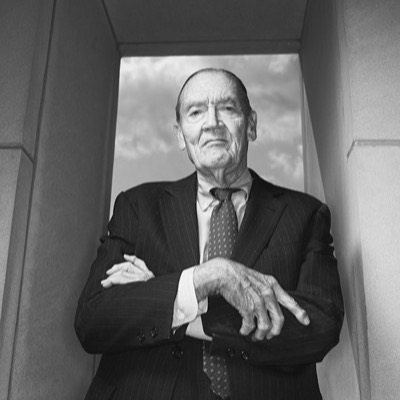
William Sharpe is an American economist, born in 1934, whose work supplied finance with two of its most widely used tools: a model of how assets should be priced given their risk, and a simple ratio for comparing returns on a risk-adjusted basis.
Building on Harry Markowitz’s portfolio framework, Sharpe asked what would follow if every investor optimised in the way Markowitz described. The capital asset pricing model, published in 1964, was his answer. It separates risk into the part that can be diversified away and the part that cannot, and argues that only the second should command a return.
He shared the Nobel Memorial Prize in Economic Sciences in 1990 with Markowitz and Merton Miller. He spent much of his career at Stanford Graduate School of Business, where he is professor emeritus, and later founded Financial Engines to bring portfolio advice to workplace retirement plans.
His 1991 essay The Arithmetic of Active Management is arguably as influential among ordinary investors as the model that won him the prize. It argues from accounting rather than from evidence that active management must, before costs, be a zero-sum game against the market it collectively comprises.
Career timeline
- 1934Born in Boston, Massachusetts.
- 1961Completes a PhD in economics at the University of California, Los Angeles.
- 1964Publishes "Capital Asset Prices", introducing the capital asset pricing model.
- 1966Introduces the reward-to-variability ratio, later known as the Sharpe ratio.
- 1970Joins Stanford Graduate School of Business.
- 1990Shares the Nobel Memorial Prize in Economic Sciences with Markowitz and Miller.
- 1991Publishes "The Arithmetic of Active Management".
- 1996Co-founds Financial Engines to provide portfolio advice to retirement plan participants.
How he approached asset pricing
Sharpe’s distinctive contribution was to separate risk into two kinds and argue that they are not compensated equally. Risk specific to one company can be removed by holding many companies, so an investor who bears it is bearing something avoidable. Risk common to the whole market cannot be removed by diversifying, so it is the part for which a return should be expected.
The second strand of his thinking is arithmetic rather than empirical. Because all investors together hold the market, the average actively managed dollar must earn the market return before costs and less than it after costs. This holds regardless of skill and requires no assumption about efficiency, which is what makes it difficult to argue with.
He was also practical about implementation. Founding Financial Engines reflected a view that the value of this research lay in getting sensible portfolios in front of ordinary savers rather than in the models alone.
Key ideas
Tap any idea to expand a plain-English explanation, why it matters, and where to learn more.
Diversifiable risk is not rewarded
Risk that can be removed by holding a broad portfolio should not, in theory, earn a return, because investors can avoid it at no cost.
It gives a reason to diversify that does not depend on forecasting: bearing avoidable risk is uncompensated by construction.
Holding one company exposes an investor to that company’s specific problems, which a broad fund would have diluted.
The Sharpe ratio
A measure of return earned above a risk-free rate per unit of variability, used to compare investments on a risk-adjusted basis.
It formalises the idea that a return figure means little until you know how much variability produced it.
Two funds with the same return are not equivalent if one delivered it with far larger swings along the way.
The arithmetic of active management
Before costs, the average actively managed dollar must earn the market return, because active investors collectively are the market.
It is an accounting identity rather than an empirical claim, so it does not depend on whether markets are efficient.
If one active investor beats the market average, another active investor must trail it by the same amount before costs.
The market portfolio as a reference point
Under the model’s assumptions, the theoretically optimal risky holding is the whole market in proportion to its value.
It provides the intellectual case for capitalisation-weighted index funds as a default rather than as a compromise.
A broad market index fund is an approximation of this reference portfolio available to ordinary investors.
Major contributions
- Developed the capital asset pricing model, formalising the relationship between systematic risk and expected return.
- Introduced the reward-to-variability ratio, now universally called the Sharpe ratio.
- Distinguished systematic from diversifiable risk and argued only the former should be compensated.
- Published The Arithmetic of Active Management, establishing the zero-sum accounting behind active investing.
- Co-founded Financial Engines to deliver portfolio advice within workplace retirement plans.
Major successes
- Shared the Nobel Memorial Prize in Economic Sciences in 1990.
- Saw the Sharpe ratio adopted as a standard risk-adjusted comparison across the investment industry.
- Served as president of the American Finance Association.
- Held the position of professor emeritus of finance at Stanford Graduate School of Business.
Important books
- Investors and Markets2007
A later treatment of asset pricing and portfolio choice aimed at practitioners as well as academics.
- Investments
A widely used finance textbook, written with Gordon Alexander and Jeffery Bailey, that carried the framework into university teaching.
Influence on investors
The Sharpe ratio is the most visible piece of his legacy: it appears on fund factsheets, in institutional reporting and in retail tools, and it has trained a generation of investors to ask what risk produced a given return.
The Arithmetic of Active Management is quoted constantly in the case for low-cost index investing, and its force comes from being an identity rather than a study, which means it cannot be overturned by a period of strong active performance.
Criticisms and debates
A balanced view includes the main criticisms and open debates, presented neutrally.
- The capital asset pricing model has performed poorly in empirical tests, and later research by Fama and French found that size and value characteristics explained returns the model did not.
- Beta, the model’s measure of systematic risk, is estimated from past data and is not stable over time.
- The model rests on assumptions that plainly do not hold, including unrestricted borrowing at a risk-free rate and investors sharing the same expectations.
- The Sharpe ratio uses variability as its risk measure, so it penalises upside movement in the same way as downside movement.
- Ratios computed over short periods can be misleading, particularly for strategies whose losses are rare but severe.
Lessons for investors
Plain-English takeaways. Context for learning, not advice to buy or sell anything.
- 1Ask what risk produced a return before deciding whether the return was good.
- 2Accept no compensation for risk you could have diversified away at no cost.
- 3Remember that active management is zero-sum before costs, so costs decide much of the outcome.
- 4Treat beta and similar estimates as approximations drawn from past data, not fixed properties.
Notable quotes
“Investors should not expect to be rewarded for taking risk that can be diversified away.”
Frequently asked questions
Who is William Sharpe?
William Sharpe is an American economist born in 1934, professor emeritus at Stanford Graduate School of Business, who shared the 1990 Nobel Memorial Prize in Economic Sciences for his work on asset pricing.
What is the capital asset pricing model?
A model relating an asset’s expected return to the portion of its risk that cannot be diversified away. Risk specific to one company is assumed to earn no premium because investors can remove it by diversifying.
What is the Sharpe ratio?
A measure of return above a risk-free rate divided by the variability of returns, used to compare investments on a risk-adjusted basis rather than on return alone.
What is the arithmetic of active management?
The observation that active investors collectively hold the market, so before costs their average return must equal the market return, and after costs it must be lower. It follows from accounting rather than from any theory of efficiency.
Is the capital asset pricing model still considered correct?
It is still taught as a foundation but has known empirical weaknesses. Later factor models, particularly the work of Fama and French, explain patterns in returns that the single-factor model does not.
How does his work relate to index funds?
The model treats the whole market portfolio as the reference risky holding, and the arithmetic argument shows the average active dollar must trail the market after costs. Together these form much of the intellectual case for broad, low-cost index funds.
Related quotes
Other people in the library writing on the same themes.
Strategies William Sharpe is associated with
How the money actually gets run, with the mechanics, the costs and the failure modes set out in full.
Related guides
Related concepts
Hubs and trackers
Related people
Build your investing system
Turn what you are learning into a repeatable process for researching investments, setting your rules, building your portfolio, and navigating markets.
Explore Money Masters OSGet smarter about investing
Clear market insights, useful tools, and beginner-friendly investing education.
Educational content only. This is a neutral summary compiled for learning. It is not an endorsement, not investment advice, and not a claim that this person is always right. Mentioning someone here does not imply they are affiliated with Money Masters Media.