
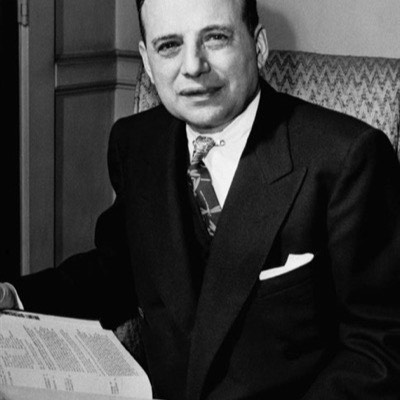
John Templeton
Founder of the Templeton Growth Fund
Born 1912 • Passed away 2008
Built one of the first genuinely global mutual funds and became known for buying in markets and countries other investors were avoiding.
Biography
John Templeton, born in Winchester, Tennessee in 1912, was an investor and fund manager known for looking for bargains anywhere in the world rather than only in his own country. He studied economics at Yale, then went to Balliol College, Oxford as a Rhodes Scholar, and travelled widely through Europe and Asia before returning to work on Wall Street.
In 1939, as war began in Europe and share prices collapsed, he borrowed money and bought small stakes in more than a hundred companies listed in the United States whose shares traded below one dollar. The idea was not that he knew which ones would survive, but that the group as a whole had been marked down by fear rather than by analysis. Most of the positions eventually recovered.
He launched the Templeton Growth Fund in 1954, one of the first funds available to American investors that bought shares across many countries. He ran it for close to four decades, moving his operation to the Bahamas in the late 1960s partly to put distance between himself and the daily mood of Wall Street. In 1992 he sold the Templeton funds to Franklin Resources.
Templeton became a British citizen and was knighted in 1987. Outside investing he funded work on questions where science and religion overlap, creating the Templeton Prize in 1972 and the John Templeton Foundation in 1987. He was born in 1912 and passed away in 2008.
Career timeline
- 1912Born in Winchester, Tennessee.
- 1934Graduates from Yale and goes to Oxford as a Rhodes Scholar.
- 1939Buys small stakes in more than a hundred low-priced US companies as war begins in Europe.
- 1954Launches the Templeton Growth Fund, one of the first US funds buying shares worldwide.
- 1968Moves his investment operation to the Bahamas, away from the daily noise of Wall Street.
- 1972Creates the Templeton Prize, funding work at the boundary of science and religion.
- 1987Is knighted, and founds the John Templeton Foundation.
- 1992Sells the Templeton funds to Franklin Resources.
- 2008Passes away at the age of 95.
Investment philosophy
Templeton treated a share price as a piece of information about crowd mood, not as a verdict on a business. His argument was that the price you pay is set by whoever is most emotional at that moment, so the best prices tend to appear where fear is thickest and the worst prices appear where enthusiasm is thickest. That is a statement about human behaviour rather than a forecast, and it is why he described bargain hunting as the opposite of prediction.
The second half of his approach was geographic. If you only look at one country you can only buy what that country happens to be offering, and in a boom it may be offering nothing cheap at all. By searching across markets he widened the pool of candidates enormously, which meant he almost always had somewhere to put money at a sensible price.
He also insisted on measuring outcomes in total real return, meaning after inflation and after tax, because a nominal gain that loses to inflation is not a gain. That habit made him sceptical of investments whose appeal depended on ignoring one of those two costs.
Key ideas
Tap any idea to expand a plain-English explanation, why it matters, and where to learn more.
The point of maximum pessimism
The idea that assets tend to be cheapest when sentiment is at its worst, and most expensive when optimism is widest.
It reframes a falling market as the moment when prices are being set by fear rather than by analysis, which is when a careful buyer has the biggest advantage.
His 1939 purchase of more than a hundred beaten-down shares was made in the weeks after war broke out, when almost nobody wanted to own equities at all.
Search the whole world for bargains
Looking for undervalued companies across many countries instead of restricting the search to a single home market.
A wider search area means more candidates. When one market is expensive, another is often cheap, so a global investor is rarely forced to overpay.
Templeton bought heavily in Japan in the 1960s, years before most American investors treated Japanese shares as investable.
Cycles repeat more than they change
The belief that claims a new era has made old valuation rules obsolete are usually the most expensive claims in investing.
Every bubble arrives with an argument for why this one is different. Treating that argument with suspicion is a cheap form of protection.
The same reasoning appeared in the late 1990s technology boom, in earlier commodity manias, and in housing before 2008.
Total real return
Judging an investment by what is left after inflation and tax, rather than by the headline gain.
Inflation and tax are the two costs most easily forgotten, and both of them compound. A return that ignores them can be an illusion.
A holding that gains five percent in a year when inflation runs at five percent has left your purchasing power exactly where it started.
Bargain hunting is not forecasting
Buying on the gap between price and an estimate of worth, rather than on a view about what the market will do next.
Forecasts require you to be right about the future. A valuation gap only requires you to be roughly right about the present and patient about the rest.
He rarely explained a purchase by saying where he thought the market was heading; he explained it by what the asset was selling for relative to its worth.
Major contributions
- Launched one of the first mutual funds that let ordinary American investors own shares from many countries in a single holding.
- Made contrarian buying into a stated, repeatable discipline rather than an instinct, most famously through his rule about maximum pessimism.
- Popularised judging results in total real return, after inflation and after tax, rather than on headline performance.
- Wrote a short set of investment rules that has been reprinted for decades as an introduction to long-term investing.
- Founded the Templeton Prize and the John Templeton Foundation, funding research well outside finance.
Major successes
- Bought more than a hundred low-priced US shares at the outbreak of the Second World War, a position widely cited as an example of buying into fear rather than away from it.
- Launched the Templeton Growth Fund in 1954 and managed it for close to four decades, a rare span of continuity for a single manager.
- Invested in Japanese companies in the 1960s, well before most Western investors treated that market as ordinary.
- Made a widely reported bet against a group of technology stocks in 2000, arguing their prices had detached from any reasonable estimate of worth.
- Sold the Templeton funds to Franklin Resources in 1992 and turned to full-time philanthropy.
Important books
- Sixteen Rules for Investment Success
A short essay setting out his rules in plain language, still circulated as an introduction to long-term investing.
- The Templeton Plan1987
Written with James Ellison, on the habits and principles he believed shaped a life as much as a portfolio.
- Discovering the Laws of Life1994
A collection of short reflections, closer to his philanthropic interests than to markets.
Influence on investors
Templeton showed individual investors that a home market is a choice rather than a boundary. The global funds that are now routine holdings for ordinary savers descend directly from the argument he was making in the 1950s, when buying foreign shares was regarded as exotic.
His framing of pessimism as an opportunity rather than a warning is now standard language among long-term investors, and it reappears in the way later writers on market cycles describe the relationship between mood and price.
Criticisms and debates
A balanced view includes the main criticisms and open debates, presented neutrally.
- Buying at the point of maximum pessimism requires spare cash and steady nerves at exactly the moment most people have neither, which makes the rule far easier to admire than to follow.
- Global bargain hunting adds currency risk, political risk and weaker disclosure standards, and those risks are hardest to judge in precisely the markets that look cheapest.
- A contrarian position can stay wrong for years before it is right, and there is no reliable way to tell an early call from a mistaken one while you are living through it.
- His later public comments about market extremes were widely reported, but a warning that a market is expensive says nothing about when it will stop being expensive.
- The record of a fund run across the 1950s to 1990s reflects opportunities, taxes and information gaps that no longer exist in the same form.
Lessons for investors
Plain-English takeaways. Context for learning, not advice to buy or sell anything.
- 1The best prices usually appear when the news feels worst, which is also when buying feels hardest.
- 2Widening where you look for value means you are rarely forced to overpay in your home market.
- 3Treat any argument that the old valuation rules no longer apply as a reason for more caution, not less.
- 4Measure results after inflation and tax, because those are the two costs that quietly compound against you.
Notable quotes
“To buy when others are despondently selling and to sell when others are avidly buying requires the greatest fortitude.”
“The four most expensive words in the English language are "this time it's different."”
“The time of maximum pessimism is the best time to buy.”
Context: Nobody identifies maximum pessimism except afterwards, which is why Templeton paired the idea with a fixed plan.
Frequently asked questions
Who was John Templeton?
John Templeton was an investor and fund manager, born in Tennessee in 1912, who founded the Templeton Growth Fund in 1954. He was known for buying shares in countries and industries that other investors were avoiding.
What is John Templeton known for?
He is known for global contrarian investing, for the idea that the best prices appear at the point of maximum pessimism, and for building one of the first US mutual funds that invested worldwide.
What was the Templeton Growth Fund?
It was a mutual fund launched in 1954 that bought shares across many countries at a time when most American funds stayed at home. It gave ordinary investors a simple way to own foreign companies.
What did Templeton mean by maximum pessimism?
He meant that assets tend to be at their cheapest when sentiment about them is at its worst, because prices at that moment are set by fear rather than by careful analysis of what a business is worth.
What can investors learn from John Templeton?
Common takeaways include widening where you look for value, treating claims that the old rules no longer apply with suspicion, and measuring results after inflation and tax rather than before.
What are the criticisms of Templeton's approach?
Contrarian buying demands cash and composure at the worst possible moment, global investing adds currency and political risk, and a cheap asset can stay cheap for a long time before anything changes.
Why did Templeton move his operation to the Bahamas?
He said the distance helped. Being outside New York meant he was not hearing the same conversations and reacting to the same daily mood as everyone else, which suited an approach built on buying what the crowd was avoiding.
Related quotes
Other people in the library writing on the same themes.
“We simply attempt to be fearful when others are greedy and to be greedy only when others are fearful.”
Warren Buffett“All I want to know is where I am going to die, so I will never go there.”
Charlie Munger“The intelligent investor is a realist who sells to optimists and buys from pessimists.”
Benjamin GrahamPhilosophies John Templeton is associated with
Schools of thought whose practitioner list names them. Association is not endorsement of the approach.
Strategies John Templeton is associated with
How the money actually gets run, with the mechanics, the costs and the failure modes set out in full.
Related guides
Related concepts
Related people

Build your investing system
Turn what you are learning into a repeatable process for researching investments, setting your rules, building your portfolio, and navigating markets.
Explore Money Masters OSGet smarter about investing
Clear market insights, useful tools, and beginner-friendly investing education.
Educational content only. This is a neutral summary compiled for learning. It is not an endorsement, not investment advice, and not a claim that this person is always right. Mentioning someone here does not imply they are affiliated with Money Masters Media.