
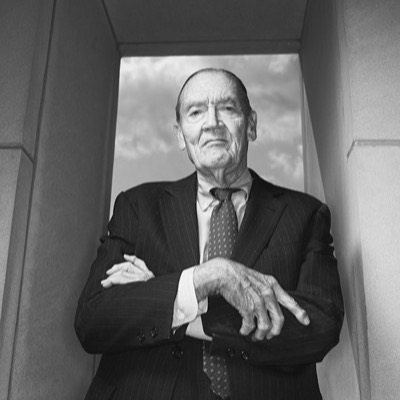
Paul Samuelson
Economist and Nobel laureate
Born 1915 • Passed away 2009
Brought mathematical rigour to economics and wrote the textbook that taught the subject to generations of students.
Biography
Paul Samuelson was an American economist, born in Gary, Indiana in 1915. He took his first degree at the University of Chicago and his doctorate at Harvard, where Joseph Schumpeter and Wassily Leontief were among his teachers, and joined the Massachusetts Institute of Technology in 1940, building its economics department into one of the strongest in the world.
His Foundations of Economic Analysis, published in 1947, rewrote economics in mathematical form and is largely responsible for the field looking the way it does. The following year he published Economics, an introductory textbook that went through nineteen editions and taught the subject to several generations. In 1970 he became the first American to receive the Nobel Memorial Prize in Economic Sciences.
Two pieces of his work reach investors directly. The first is a 1965 paper, Proof That Properly Anticipated Prices Fluctuate Randomly, which shows that if a price already incorporates expectations about the future, then changes in it must be unpredictable. The randomness is a consequence of anticipation rather than evidence of disorder, and this is one of the foundations the efficient-market literature was built on.
The second is more direct. In 1974, in the first issue of the Journal of Portfolio Management, he published a short article called Challenge to Judgment arguing that most active managers did not beat the market and that somebody should therefore establish a fund that simply tracked an index. Jack Bogle launched the first index fund available to ordinary investors two years later and repeatedly credited that article as a spur.
He also spent years arguing against the Kelly criterion as a general objective, on the grounds that maximising the long-run growth rate of wealth does not follow from expected utility for investors whose preferences differ. He made the point in 1979 in a paper written almost entirely in words of one syllable, apparently to remove any excuse for misunderstanding it. He wrote a Newsweek column from 1966, alternating with Milton Friedman, and passed away in 2009.
Career timeline
- 1915Born in Gary, Indiana.
- 1935Graduates from the University of Chicago.
- 1940Joins the Massachusetts Institute of Technology.
- 1941Completes his doctorate at Harvard University.
- 1947Publishes Foundations of Economic Analysis.
- 1948Publishes Economics, which becomes the dominant introductory textbook.
- 1965Publishes Proof That Properly Anticipated Prices Fluctuate Randomly.
- 1970Becomes the first American to receive the Nobel Memorial Prize in Economic Sciences.
- 1974Publishes Challenge to Judgment, calling for someone to establish an index fund.
- 2009Passes away at the age of 94.
How he thought about markets and investors
Samuelson's 1965 result is more careful than the way it is usually reported. He did not prove that markets are efficient or that prices are correct. He proved something narrower and more durable: that if a price already reflects expectations about future events, then the change in that price must be unforecastable, because any forecastable part would already have been incorporated. Randomness is therefore what a well-anticipated price should look like, and observing it tells you about anticipation rather than about wisdom.
The 1974 article turns that into a practical position, and it is unusual for an academic argument in that it names a product that did not exist. His claim was that the evidence on active management did not support its cost, that a fund tracking an index would serve most investors better, and that since no such fund existed for ordinary people, someone ought to build one. He wrote that if nobody would do it, a university endowment should. Bogle did it two years later.
His disagreement about the Kelly criterion runs the other way and is worth understanding alongside the indexing argument, because both are about not overclaiming. Maximising the expected logarithm of wealth produces the highest long-run growth rate, which is a real mathematical result. Samuelson's objection was that this is only the correct objective for an investor whose preferences happen to match that formula, and that presenting it as universally optimal smuggles in an assumption about risk tolerance that most people do not share.
The thread across all three is a refusal to let a correct narrow result be reported as a broader one. He established what randomness in prices does and does not imply, what the evidence on active management supported, and what growth-optimal sizing does and does not prove. In each case the popular version claims more than he did.
Key ideas
Tap any idea to expand a plain-English explanation, why it matters, and where to learn more.
Anticipated prices fluctuate randomly
If a price already incorporates expectations, its changes must be unpredictable, because any predictable part would already be reflected.
It explains why random-looking prices are a sign of anticipation rather than of disorder or irrationality.
A forecastable move would be acted on immediately, which removes the forecastability.
Challenge to Judgment
His 1974 argument that most active management did not justify its cost and that someone should launch an index-tracking fund.
It is the intellectual case for indexing stated before the product existed, by an economist with no commercial interest in it.
The first index fund available to ordinary investors launched two years later.
Cost is the reliable part of the argument
The case for indexing rests on the arithmetic of fees rather than on any claim that markets are perfectly efficient.
It is why the argument survives even for readers who reject efficient-market theory entirely.
Active management collectively must trail the index by roughly what it charges.
Growth-optimal is not universally optimal
Maximising the long-run growth rate of wealth is only correct for an investor whose risk preferences match that objective.
It is a direct caution about position sizing rules presented as mathematically compulsory.
He made the argument in a paper written almost entirely in single-syllable words.
A narrow proof is not a broad claim
He was consistently precise about what each of his results did and did not establish.
The gap between his statements and their popular versions is a useful lesson in reading financial research.
The random-walk result is routinely reported as proof that markets are efficient, which is not what it shows.
Major contributions
- Published Foundations of Economic Analysis, which established the mathematical form of modern economics.
- Wrote Economics, the dominant introductory textbook for several decades.
- Proved that properly anticipated prices fluctuate randomly, a foundation of the efficient-market literature.
- Published Challenge to Judgment in 1974, calling for the creation of an index-tracking fund.
- Argued at length against treating the Kelly criterion as a universal objective for investors.
Major successes
- Became the first American to receive the Nobel Memorial Prize in Economic Sciences, in 1970.
- Built the economics department at the Massachusetts Institute of Technology into a leading one.
- Published a textbook that ran to nineteen editions and was translated into many languages.
- Advised President John F. Kennedy and wrote a long-running Newsweek column.
Important books
- Foundations of Economic Analysis1947
The book that put economics into systematic mathematical form. Technical, and the reason the discipline reads as it does today.
- Economics1948
The introductory textbook that taught the subject to several generations of students across nineteen editions.
- Challenge to Judgment1974
A short article rather than a book, published in the first issue of the Journal of Portfolio Management, calling for someone to establish an index fund. Bogle credited it directly.
Influence on investors
The index fund industry traces part of its intellectual origin to a four-page article by an economist with nothing to sell. Bogle repeatedly cited Challenge to Judgment, and the argument it makes is still the one indexing rests on.
His 1965 randomness result gave the efficient-market literature its formal footing, though he was more careful than most of what followed about what it actually implied.
His long objection to growth-optimal position sizing remains the standard citation for anyone arguing that a mathematically attractive betting rule is not automatically the right objective for a real investor.
Criticisms and debates
A balanced view includes the main criticisms and open debates, presented neutrally.
- The randomness result is frequently reported as proof that markets are efficient, which overstates it. Samuelson was careful about the distinction; much of the literature citing him was not.
- Early editions of his textbook carried growth projections for centrally planned economies that did not materialise, an error corrected in later editions and still cited against him.
- His mathematisation of economics is criticised for making the field less accessible and for favouring problems that are tractable over ones that matter.
- His critique of the Kelly criterion is contested by practitioners who argue he attacked a stronger claim than growth-optimal sizing actually makes.
- The best-known line attributed to him, comparing good investing to watching paint dry, has no identified original source and this library records it as attributed rather than verified.
Lessons for investors
Plain-English takeaways. Context for learning, not advice to buy or sell anything.
- 1Read what a result actually proves before accepting the claim built on top of it.
- 2Treat the fee arithmetic as the durable part of the indexing case, independent of any theory about efficiency.
- 3Be sceptical of a position-sizing rule presented as mathematically compulsory rather than as one objective among several.
- 4Expect unpredictable price changes to be a symptom of anticipation rather than evidence of chaos.
Notable quotes
“Investing should be more like watching paint dry or watching grass grow. If you want excitement, go to Las Vegas.”
Frequently asked questions
Who was Paul Samuelson?
Paul Samuelson was an American economist born in 1915 who taught at the Massachusetts Institute of Technology and in 1970 became the first American to receive the Nobel Memorial Prize in Economic Sciences. He passed away in 2009.
What did his 1965 paper prove?
That if a price already incorporates expectations about the future, its changes must be unpredictable. Randomness follows from anticipation. It does not prove that markets are efficient or that prices are correct.
What was Challenge to Judgment?
A 1974 article in the first issue of the Journal of Portfolio Management arguing that most active managers did not justify their cost and that someone should launch a fund tracking an index. Jack Bogle did so two years later and credited the article.
Why did he argue against the Kelly criterion?
Because maximising the long-run growth rate of wealth is only the right objective for an investor whose risk preferences match it. He held that presenting it as universally optimal assumes a risk tolerance most people do not have.
Did he say investing should be like watching paint dry?
That line is widely attributed to him but has no identified original source. This library records it as attributed rather than verified and does not present it as a sourced quotation.
Why does the history of index investing start with him?
Because he made the public case for an index fund before any existed for ordinary investors, in an article Bogle credited as a spur. The argument came before the product.
Related quotes
Other people in the library writing on the same themes.
Philosophies Paul Samuelson is associated with
Schools of thought whose practitioner list names them. Association is not endorsement of the approach.
Related guides
Related concepts
Related people
Build your investing system
Turn what you are learning into a repeatable process for researching investments, setting your rules, building your portfolio, and navigating markets.
Explore Money Masters OSGet smarter about investing
Clear market insights, useful tools, and beginner-friendly investing education.
Educational content only. This is a neutral summary compiled for learning. It is not an endorsement, not investment advice, and not a claim that this person is always right. Mentioning someone here does not imply they are affiliated with Money Masters Media.