
Index Investing
Owning an entire market at the lowest possible cost instead of trying to select the parts of it that will do best.
Overview
Index investing rests on arithmetic rather than on a view about markets. Investors as a group earn the market return before costs and less after them, so active management collectively must trail the index by roughly what it charges. The response is to stop paying for selection.
How the philosophy developed
The intellectual groundwork was laid by academics studying whether share prices could be predicted, and by Paul Samuelson, who in 1974 publicly challenged someone to start a fund that simply tracked an index.
Jack Bogle founded Vanguard the same year and launched the first index fund available to ordinary investors in 1976. It raised a small fraction of its target and the industry nicknamed it Bogle's Folly, with one competitor distributing posters calling indexing un-American.
The structural decision mattered as much as the product. Bogle arranged for Vanguard's funds to own the management company, so profits returned to investors as lower fees rather than to outside shareholders, which removed the conflict that would have made continuous fee cutting irrational. Index funds now hold a substantial share of all invested assets in the United States.
Core principles
- Before costs, investors as a group earn exactly the market return, so after costs they must earn less. This is arithmetic and holds regardless of whether markets are efficient.
- Cost is the only input known in advance, which makes it the one reliable lever an investor controls.
- Owning the whole market removes the need to identify winners, which is the part that has proved hardest to do consistently.
- Most of the avoidable damage comes from behaviour rather than from selection, so a product that requires no decisions has an advantage beyond its fee.
How decisions get made
There is almost no security selection, which is the point. The decisions that remain are which markets to own, in what proportion, and how much to hold in bonds against equities.
Contributions are usually automated so that no judgment is exercised at the moment of purchase, which removes the most common source of self-inflicted loss.
The remaining discipline is rebalancing back to the chosen proportions occasionally, which mechanically sells what has risen and buys what has fallen without requiring a view about either.
How it approaches risk
Risk is treated as something to be chosen through asset allocation rather than reduced through selection. The split between equities and bonds does the work that stock picking does in other philosophies.
The approach offers no protection in a broad decline, which its advocates state openly. A market-tracking fund follows the market down in full, and the defence is the investor's time horizon and allocation rather than anything in the product.
How portfolios are built
A small number of broad funds held in fixed proportions, often as few as two or three, covering domestic equities, international equities and bonds.
Weighting is by market value, which means the portfolio holds more of whatever is already largest. That is what makes it the market rather than a bet against it, and it is also the source of the concentration criticism as a handful of very large companies have come to dominate major indices.
Time horizon
Decades. The case depends on capturing a long-run market return net of very low costs, and the arithmetic that makes it work is most visible over periods long enough for fee differences to compound.
Where the approach can work well
- The main variable, cost, is known before committing and does not depend on skill, forecasting or luck.
- It requires no security analysis, which suits the large majority of people who will not do that work.
- Very low turnover keeps taxes and trading costs down, which compounds over decades.
- It removes most of the moments at which an investor can do something damaging, because there are almost no decisions to make.
- The evidence base is unusually strong: active management as a group trailing the index after costs is one of the most consistently reproduced findings in finance.
Limitations and criticisms
A balanced view includes where the approach struggles, presented neutrally.
- It guarantees the market return minus a small fee, which means accepting the full decline in a bear market with no defence built in.
- Market-value weighting concentrates money in whatever is already largest, and index concentration has increased materially.
- It holds overvalued parts of the market in full by design, and offers no way to express a view that something is mispriced.
- If enough capital is invested without regard to price, the job of setting sensible prices falls to a shrinking group, and nobody knows where that threshold is.
- The simplicity is behavioural rather than emotional: doing nothing during a severe decline is easy to describe and hard to do.
Common misconceptions
- The claim
Index investing means settling for average.
What is actually the caseIt means capturing the market return net of very low costs, which after fees has beaten the majority of professional managers over long periods. The comparison is to what other investors actually achieve, not to a hypothetical best.
- The claim
It only works because markets are efficient.
What is actually the caseBogle deliberately avoided that argument. His case is subtraction: costs come out of a fixed pool of market return, which holds whether or not prices reflect information.
- The claim
Index funds are risk free.
What is actually the caseThey carry the full risk of the market they track. What they remove is the additional risk of selecting badly and the certainty of high fees.
Investors associated with this approach
Listed because of a documented intellectual connection to the approach, not because they are well known.
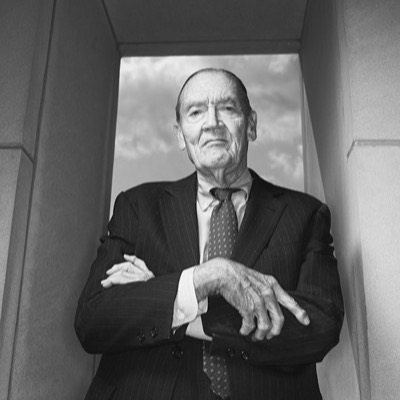 Jack BogleFounder of VanguardEugene FamaEconomist and Nobel laureateWilliam BernsteinNeurologist turned author on asset allocationJeremy SiegelProfessor and author of Stocks for the Long RunJL CollinsAuthor of The Simple Path to WealthDavid SwensenLongtime chief investment officer of the Yale endowmentPaul SamuelsonEconomist and Nobel laureate
In their words
“Do not look for the needle in the haystack. Just buy the haystack.”
“In investing, you get what you do not pay for.”
“A low-cost index fund is the most sensible equity investment for the great majority of investors.”
“A blindfolded monkey throwing darts at a newspaper's financial pages could select a portfolio that would do just as well as one carefully selected by experts.”
Strategies that put this into practice
A philosophy is what an investor believes. These are the procedures people run on the strength of it.
Related guides
Related concepts
Useful tools
Markets and hubs
Investor comparisons
Related philosophies
Frequently asked questions
Why do index funds beat most active funds?
Because of subtraction rather than cleverness. All investors together own the market, so their combined return before costs is the market return and after costs must be less. Active management as a group therefore trails the index by roughly what it charges, whatever any individual manager achieves.
Why is cost the central argument for indexing?
Jack Bogle's alternative to the efficient market hypothesis. It says the arithmetic of costs alone explains why active management collectively trails, so the conclusion holds even if markets are irrational. He preferred it because it does not depend on any theory about how prices are set.
Do index funds protect you in a crash?
No, and advocates say so plainly. A fund tracking a market follows it down in full. Protection comes from asset allocation and from the investor's time horizon, not from anything inside the product.
What happens if everyone indexes?
Nobody knows, which is the honest answer. If enough capital is invested without regard to price, the job of setting sensible prices falls to a shrinking group of active managers. Indexing has grown enormously without the predicted breakdown, but the threshold has never been identified.
Is index concentration a problem?
It is a real and unresolved concern. Weighting by market value means buying more of a company as it gets larger, so index investors have become heavily exposed to a handful of very large firms. Any alternative weighting is an active decision, which is the trade-off.
Get smarter about investing
Clear market insights, useful tools, and beginner-friendly investing education.
Educational content only. This page explains how an investing approach works and where it falls short. It is not a recommendation to adopt it, not investment advice, and not a claim that any approach suits your circumstances.