
Core and Satellite
Holding most of the portfolio in a low-cost index core and expressing any active views in small, deliberately limited satellites.
What the strategy is
Core and satellite splits a portfolio into two parts with different jobs. The core, usually the large majority, is broad index exposure held indefinitely and expected to supply the market return at almost no cost. The satellites are small deliberate positions that express a view, sized so that being wrong about them cannot change the outcome very much.
How it works
The investor first decides the core, which is broad market exposure through one or a few index funds and is not the place where opinions are expressed. Everything about the core is designed to be dull: wide diversification, minimal cost, no turnover, no view about which sector or manager will do well.
The remaining share, commonly somewhere between ten and thirty percent, is divided among satellites. A satellite can be an individual company, a sector fund, an active manager, a factor tilt or an asset the core does not reach. Each one is sized in advance, and the size is the risk control: a position capped at three percent cannot damage the portfolio no matter how wrong it turns out to be.
The two halves are then reviewed on different terms. The core is judged only on whether it still tracks the market cheaply, which is a maintenance question. Each satellite is judged on whether its specific reason for existing still holds, and the honest version of the strategy retires satellites that fail that test rather than letting them quietly become permanent.
Advantages
- It separates two decisions that investors usually blend badly: getting market exposure, and betting on something. Keeping them in different accounts of the mind makes the second one visible and countable.
- The cost of being wrong is bounded before the position is opened, because the sizing is the rule rather than the conviction.
- It keeps the portfolio's overall cost near the index level, since the expensive parts are a small share of the money.
- It gives an investor who wants to be involved somewhere to be involved, which in practice is what stops them tinkering with the part that should be left alone.
Disadvantages
Stated at the same length as the advantages, because a strategy page that only lists upsides is marketing.
- Satellites accumulate. Each one is added for a reason and few are ever removed, so a portfolio that started at eighty twenty drifts toward something with no core discipline left in it.
- It creates work that the core alone would not need, and the work is on the part of the portfolio least likely to justify it.
- The performance of satellites is hard to judge honestly. A small position that doubles feels like skill and rarely moves the total, and the tendency is to remember those and forget the others.
- In a taxable account the satellite turnover produces realised gains that the core would not have created.
- It can encourage the belief that having a core makes the satellites safe. It makes them survivable, which is a different claim.
Who typically uses it
- Advisers running individual portfolios who need most of the money in something defensible while leaving room for the client to hold positions they care about.
- Investors who have accepted the evidence for index funds but are not willing to run a portfolio with no discretion in it at all, which is a large group and an honest position.
- Institutions applying the same shape at a larger scale, with a passive core and a limited allocation to managers they believe add something, which is close to how many endowment portfolios are structured.
- It fits poorly for someone who does not intend to research the satellites. An unresearched satellite is not a considered bet, it is a fee.
Historical examples
Specific, checkable episodes rather than illustrations, including the ones where the strategy cost money.
The endowment model as the institutional version
David Swensen's work at Yale from 1985 onward is the best documented example of a portfolio built as a low-turnover base plus deliberately chosen active exposures, though at Yale the active share was much larger than a retail satellite. What makes it relevant is Swensen's own conclusion for individuals, published in Unconventional Success in 2005: he argued that most private investors have no access to the manager quality the model depends on, and recommended low-cost index funds instead. The strategy and its author's warning about it arrived together.
Index funds becoming cheap enough for the core to be free
The idea only works if the core costs almost nothing, and for most of the twentieth century it did not. Broad index funds arrived for retail investors in 1976 with Vanguard's First Index Investment Trust, and price competition over the following decades pushed the expense ratios on mainstream index funds toward a few hundredths of one percent. The strategy is a product of that price collapse rather than a discovery about markets.
Closet indexing, the problem it was built to expose
A recurring finding in fund research is that many actively managed funds hold portfolios close to their benchmark while charging active fees, so investors pay for a difference they are not receiving. Core and satellite is a direct response: separate the index exposure and buy it at index prices, then pay active fees only on the portion that is genuinely different. Whether the satellites earn those fees is a separate question the structure does not answer.
Risks
- Satellite drift, where the active share grows through additions and never shrinks, until the portfolio has the cost of an active fund and the coherence of neither approach.
- Concentration hiding inside diversification. A core tracking a market-cap weighted index already leans heavily toward the largest companies, and a satellite in the same names doubles a bet the investor thought they had spread.
- Cost drag, when several small expensive positions add up to a fee that the low-cost core was supposed to prevent.
- Attribution failure. Without keeping a record, an investor cannot tell whether the satellites have added anything, and the default assumption in the absence of a record is generous.
Common mistakes
- Never writing down why a satellite exists, which makes it impossible to know later whether the reason has expired.
- Letting satellites exceed their intended share after a good run, so the position that was capped at three percent is now twelve and the cap has stopped meaning anything.
- Duplicating the core inside the satellites, most often by adding a large-cap growth fund alongside a total market fund that already holds the same companies.
- Treating a satellite as a trial position that will be scaled up if it works, which converts a bounded bet into an unbounded one at the worst moment.
- Measuring satellites against each other rather than against the core, which answers the wrong question. The question is whether they beat simply holding more of the core.
Common misconceptions
- The claim
Core and satellite is a way to beat the market safely.
What is actually the caseIt is a way to bound the cost of trying. The satellites can still be wrong, and most of the evidence on active selection suggests they often will be. What the structure guarantees is the size of the damage, not the direction of the result.
- The claim
The core has to be a single fund.
What is actually the caseThe core is defined by its job rather than its count. One total market fund, a pair covering domestic and international equities, or a stock and bond combination all qualify as long as the exposure is broad, cheap and not an expression of a view.
- The claim
Satellites should be where the conviction is highest, so they should be large.
What is actually the caseThat reverses the design. The satellite share is set by how much the portfolio can afford to lose on active decisions, not by how confident the investor currently feels. Confidence is the input the strategy is specifically built to distrust.
Investors associated with this strategy
Listed because of a documented connection to the approach, not because they are well known.
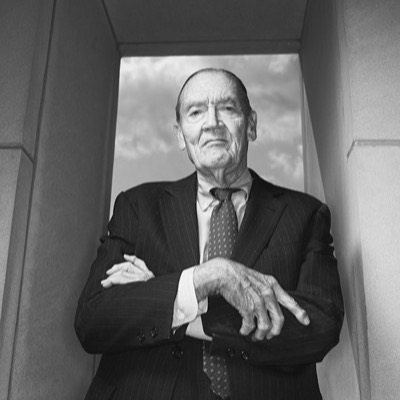 Jack BogleFounder of VanguardWilliam BernsteinNeurologist turned author on asset allocationDavid SwensenLongtime chief investment officer of the Yale endowmentCharles EllisInvestment consultant and author of Winning the Loser’s GameBurton MalkielEconomist and author of A Random Walk Down Wall Street
In their words
“In investing, you get what you do not pay for.”
“Investors should pursue a simple strategy of holding low-cost index funds.”
“Investing is a loser's game: the winner is the one who makes the fewest mistakes.”
Related guides
Related concepts
Related calculators
Related market pages
Related investing philosophies
Related investor comparisons
Related strategies
Frequently asked questions
How big should the satellite portion be?
There is no established figure and this page does not set one for any individual. The principle practitioners state is that the satellite share should be the amount whose complete loss would not change the plan, which is a far smaller number than most people first reach for. In published descriptions of the approach it commonly sits between ten and thirty percent.
What can be a satellite?
Anything the core does not already provide and that has a specific reason for being there: an individual company, a sector or thematic fund, a factor tilt, an actively managed fund, or an asset class outside the core such as commodities. The test is not what it is but whether it adds something the core lacks and whether its size is capped in advance.
Is core and satellite the same as having a play account?
The structures look alike and the discipline is different. A play account has a size limit; core and satellite adds a stated reason for each position and a review that retires the ones whose reason has expired. Without that second half it is a play account with a more serious name.
Does this approach cost more than pure indexing?
Yes, by design, and how much more depends on the satellites. The core keeps the majority of the money at index cost, so the total is far closer to indexing than to running an actively managed portfolio, but the difference is real and it is the price of the discretion the structure allows.
How do you know whether the satellites are working?
By comparing them against the alternative of holding more of the core over the same period, including their costs and any realised tax. That is the only comparison that answers the question. Judging satellites against each other, or remembering the ones that did well, produces a flattering answer that has no information in it.
What happens if a satellite grows very large?
It stops being a satellite and becomes an unplanned concentration. The structure calls for trimming it back to its intended weight, which is the same mechanical instruction rebalancing gives and is equally uncomfortable, because the position being cut is the one that has been working.
Sources
Where the dates, figures and claims on this page come from. Book and paper citations carry no link because the durable reference is the title rather than any one copy of it.
- David Swensen, Unconventional Success, 2005
- David Swensen, Pioneering Portfolio Management, 2000
- Charles D. Ellis, Winning the Loser's Game, first published 1998
- Burton Malkiel, A Random Walk Down Wall Street, first published 1973
- John C. Bogle, Common Sense on Mutual Funds, 1999
Get smarter about investing
Clear market insights, useful tools, and beginner-friendly investing education.
Educational content only. This page explains how an investing strategy works and where it fails. It is not a recommendation to use it, not investment advice, and not a claim that any strategy suits your circumstances.