
Jack Bogle vs Peter Lynch
Overview
This is the clearest live disagreement in retail investing and both sides have unusually strong evidence. Bogle argued from arithmetic that active management as a group must trail the index by roughly what it charges. Lynch argued from a public record that an individual willing to do research holds advantages a professional does not.
What makes the pairing useful is that neither position refutes the other. Bogle's claim is about the average and is mathematically unavoidable. Lynch's is about a minority willing to work, and he was explicit that anyone unwilling should buy a fund instead.
Quick comparison
| Dimension | 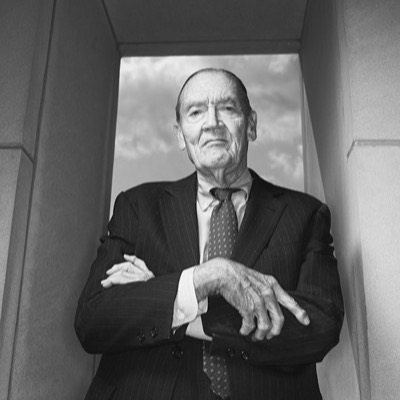 Jack Bogle Jack Bogle | Peter Lynch |
|---|---|---|
| Investment philosophy | Own the whole market and refuse to pay for the attempt to beat it. | Research individual companies you can understand and hold them for years. |
| Risk philosophy | Risk is cost and behaviour, both of which the investor controls. | Risk is not understanding what you own. |
| Valuation approach | Not performed. The market price is accepted as given. | Earnings growth measured against the multiple being paid. |
| Portfolio construction | One or a few broad funds, weighted by market value. | Many individual holdings, at times more than a thousand at Magellan. |
| Diversification | Total, and the entire point of the product. | Extensive in practice, but as a by-product of researching many companies. |
| Market timing | Never, and the single most damaging thing an ordinary investor does. | Never, and specifically not on macroeconomic grounds. |
| Economic beliefs | Irrelevant to the decision. Costs are knowable and forecasts are not. | Irrelevant, and a distraction from answerable questions. |
Scroll the table sideways on a narrow screen. Each dimension is explained in full below.
Investment philosophy
Own the whole market and refuse to pay for the attempt to beat it.
Research individual companies you can understand and hold them for years.
Bogle's case rests on subtraction rather than on market efficiency: costs come out of a fixed pool of return. Lynch's rests on the observation that a private investor faces none of the career and redemption pressures that constrain a fund manager.
Risk philosophy
Risk is cost and behaviour, both of which the investor controls.
Risk is not understanding what you own.
For Bogle the reliable dangers are fees compounding against you and the urge to act during declines. For Lynch the danger is owning a company whose story you cannot state in two sentences, because you will have no way to tell whether the reason still holds.
Valuation approach
Not performed. The market price is accepted as given.
Earnings growth measured against the multiple being paid.
This is the sharpest methodological split. Bogle does no valuation at all by design. Lynch popularised comparing the price-to-earnings ratio against the growth rate, a rough test of whether a fast-growing company is actually expensive.
Portfolio construction
One or a few broad funds, weighted by market value.
Many individual holdings, at times more than a thousand at Magellan.
Both end up owning a great deal of the market, which is a real irony the critics of each have noticed. The difference is that Lynch chose each position and could size it, while Bogle deliberately made no choices at all.
Diversification
Total, and the entire point of the product.
Extensive in practice, but as a by-product of researching many companies.
Lynch's breadth came from a research pipeline rather than from a belief in spreading risk. He argued a portfolio needs only a few very large winners and that the rest are the cost of finding them.
Market timing
Never, and the single most damaging thing an ordinary investor does.
Never, and specifically not on macroeconomic grounds.
They agree completely here. Bogle documented that fund investors reliably buy after good years and sell after bad ones. Lynch made the same point about his own shareholders and said the time spent forecasting the economy would be better spent reading one more annual report.
Economic beliefs
Irrelevant to the decision. Costs are knowable and forecasts are not.
Irrelevant, and a distraction from answerable questions.
Another point of agreement. Neither built anything on a macro view, and both were dismissive of investors who did.
Famous books
- Bogle on Mutual Funds1993Jack Bogle
His first book for a general audience, explaining how funds actually work and what their costs do to a long-term holding. It arrived when fund marketing was almost entirely about past performance, and its contribution was to redirect attention to the expense ratio. Dated in its examples but the reasoning is intact.
- Common Sense on Mutual Funds1999Jack Bogle
The fullest statement of the case, combining the arithmetic of costs with data on how active funds actually fared against their benchmarks over long periods. It is the book professionals argue with, because it makes the quantitative case rather than the rhetorical one. Longer and more demanding than his later work.
- The Little Book of Common Sense Investing2007Jack Bogle
The short version, written for readers with no background at all, and the one most often recommended to beginners. It compresses fifty years of argument into a few hours of reading without softening the conclusion. Buffett has said that if a statue is ever built to honour the person who has done most for American investors, it should be Bogle, and this is the book that made the case to the public.
- Enough2008Jack Bogle
Written after the financial crisis and concerned less with method than with what finance is actually for. It argues that the industry has confused cost with value and speculation with investment. The most personal of his books and the least practical.
- Stay the Course2018Jack Bogle
His last book, a history of Vanguard written from the inside, including the boardroom fight that created it and the mistakes he made along the way. Useful mainly as the record of how the structure came about, told by the person who designed it.
- One Up on Wall Street1989Peter Lynch
Written with John Rothchild and the book that made him famous outside the industry. It sets out the six company categories, the argument that individuals hold real advantages over professionals, and the research process he expected readers to follow. It became influential because it arrived with a public record behind it, so the claim that an amateur could do this work was hard to dismiss. It is still the standard first recommendation for anyone wanting to analyse individual companies.
- Beating the Street1993Peter Lynch
The practical follow-up, built around worked examples of decisions he actually made at Magellan, including several that went wrong. Its most useful section walks through how he prepared for and conducted company visits. Less quoted than the first book and more useful to anyone who has already accepted the argument and wants the method.
- Learn to Earn1995Peter Lynch
Written with John Rothchild for readers with no background at all, including teenagers. It covers what a company is, why shares exist and how a business is financed before any question of picking one arises. Worth knowing about mainly as the entry point below the other two.
Famous quotes
Jack Bogle“Do not look for the needle in the haystack. Just buy the haystack.”
“In investing, you get what you do not pay for.”
“Know what you own, and know why you own it.”
“Far more money has been lost by investors preparing for corrections than has been lost in corrections themselves.”
Biggest successes
- Founded The Vanguard Group in 1974 with a structure in which the funds themselves own the management company. This is the achievement everything else rests on, because it removed the conflict that would otherwise have made continuous fee cutting irrational for the firm doing the cutting.
- Launched the first index mutual fund available to ordinary investors in 1976. It raised a small fraction of its target and was mocked in the industry as settling for average, which is worth remembering given that the same product category later reshaped how most people invest.
- Abolished sales loads in 1977 and moved Vanguard to selling directly to investors. Removing the broker from between the fund and the buyer cut a layer of cost that most of the industry treated as immovable, and it forced competitors to justify their own.
- Ran Fidelity's Magellan Fund from 1977 to 1990, taking it from a small vehicle closed to new money to the largest mutual fund in the United States. The record it produced over those thirteen years is among the most studied in the industry, and it was built on company research rather than on any macroeconomic call.
- Visited companies and spoke to management on a scale almost no other manager attempted, at times holding well over a thousand positions. The breadth was the strategy: examining far more businesses than a conventional manager gave him more chances of finding the few that were obviously mispriced.
- Wrote One Up on Wall Street in 1989, which reached a readership investment books had never touched. It mattered because it argued, credibly and from a public record, that a non-professional could research a company, and it changed who believed stock analysis was available to them.
Biggest criticisms
A balanced view includes the main criticisms of each approach, presented neutrally.
- The scale objection is the one taken most seriously. Critics argue that if enough money is invested without regard to price, the job of setting sensible prices falls to a shrinking group of active managers, and that this could distort markets in ways nobody has yet had to live through. Supporters answer that a great deal of trading volume is still active and that indexers are price takers rather than price setters. What history shows so far is inconclusive: indexing has grown enormously without the predicted breakdown, but nobody can say where the threshold is, and Bogle himself acknowledged the concern rather than dismissing it.
- Indexing offers no protection in a decline, which critics treat as a real cost rather than a technicality. A broad fund follows the market down in full, and an investor near retirement in a severe bear market has no defence built into the product. Supporters reply that active funds did not reliably protect anyone either, and that the answer is asset allocation rather than stock selection. The evidence broadly supports the supporters: active funds as a group have not shown consistent downside protection, though individual ones have.
- A market-weighted index concentrates money in whatever is already largest. Critics point out that this means buying more of a company precisely as it becomes more expensive, and that index investors have ended up heavily exposed to a handful of very large firms. Supporters answer that weighting by size is what makes the fund the market rather than a bet against it, and that any alternative weighting is an active decision. The concern has grown more concrete as index concentration has increased, and it remains genuinely unresolved.
- His most famous phrase has done real damage. Critics argue that invest in what you know is routinely taken as permission to buy a company because you like its product, which skips the research the phrase was meant to introduce. Supporters point out that Lynch spent years saying exactly this and devoted whole chapters to the work that follows the observation. History is unkind to both: the slogan spread and the chapters did not, which suggests a message this easy to misread carries some responsibility for the misreading.
- The era did a great deal of the work. Critics note that 1977 to 1990 was an exceptional stretch for American equities and especially for the smaller companies he favoured, and that a strategy tested only in a rising market has not really been tested. Supporters answer that he also navigated the 1987 crash without abandoning the approach. What can be said is that no comparable manager has reproduced the record since, which points at conditions as much as at method.
- Investors in the fund did much worse than the fund. Fidelity's own later analysis found that the average Magellan investor earned far less than the fund reported, because money arrived after good years and left after bad ones. Supporters observe that this is a fact about investor behaviour rather than about Lynch. Critics reply that a manager who attracts money he cannot stop people mistiming is producing a return most of his customers will never see, which is a real limitation on what the record demonstrates.
Lessons investors can learn
Plain-English takeaways. Context for learning, not advice to buy or sell anything.
- 1The arithmetic that active management must trail the index on average says nothing about any particular investor.
- 2Both approaches fail the same way, through buying after good years and selling after bad ones.
- 3Choosing between them is a question about how much work you will genuinely do, not about which is cleverer.
Who each approach suits
Almost everyone, on his own argument: anyone who does not want investing to be a second job, and who values a result they will actually keep over one they might achieve.
People who will genuinely read annual reports and hold for years, and who accept that most of what they buy will be ordinary.
Common misconceptions
- The claim
Lynch thought everyone should pick stocks.
What is actually the caseHe was explicit that anyone unwilling to do the research should buy a fund instead. His argument was that stock picking is not closed to non-professionals, not that it is easy or advisable for all.
- The claim
Bogle thought markets were efficient.
What is actually the caseHe deliberately avoided that argument. His case is arithmetic about costs and holds whether or not prices reflect information, which is why he preferred it to the academic version.
- The claim
Magellan investors got Magellan's returns.
What is actually the caseFidelity's own later analysis found the average investor in the fund earned considerably less, because money arrived after strong years and left after weak ones.
Frequently asked questions
Did Peter Lynch and Jack Bogle actually disagree?
On what most people should do, less than it appears. Lynch accepted that investors unwilling to do research should buy a fund. The genuine disagreement is whether a diligent individual can do better than the index, which Bogle thought was true only for a minority too small to identify in advance.
Is index investing better than picking stocks?
For most people the evidence favours the low-cost index fund after costs and behaviour are accounted for. That is a statement about averages. It does not establish that no individual can do better, only that identifying who will in advance has proved very difficult.
Does the cost argument disprove what Lynch did?
No, and Bogle never claimed it did. His arithmetic says active management as a whole must trail the index by roughly what it charges, which is a statement about the aggregate. It is fully compatible with a minority of managers doing better, and his position was that identifying them in advance has proved close to impossible.
Why did Lynch think individuals had an advantage?
Because a private investor answers to nobody. A fund manager cannot easily buy an unknown small company, is measured every quarter and faces redemptions. An individual can buy something unfashionable and wait five years without explaining themselves.
Can you do both?
Many people hold a broad index fund as the core and pick individual companies with a small portion. Bogle suggested confining stock picking to a small share kept separate from the serious money, so that the lesson stays affordable if it goes badly.
Investing philosophies behind this debate
Schools of thought one or both of these investors are associated with.
Strategies these investors are associated with
What the disagreement looks like as an actual way of running a portfolio.
Related guides
Related concepts
Related tools
Hubs and trackers
Read the full profiles
Related investors
 Warren BuffettChairman and CEO of Berkshire HathawayMorgan HouselAuthor of The Psychology of MoneyPhilip FisherGrowth investor and author of Common Stocks and Uncommon ProfitsJoel GreenblattFounder of Gotham Capital and author
More comparisons
Get smarter about investing
Clear market insights, useful tools, and beginner-friendly investing education.
Educational content only. This is a neutral comparison compiled for learning. It is not an endorsement of either approach, not investment advice, and not a claim that either person is always right. Mentioning someone here does not imply they are affiliated with Money Masters Media.